How to Hire and Train Laundromat Attendants
SudsList Editorial · Jul 26, 2026
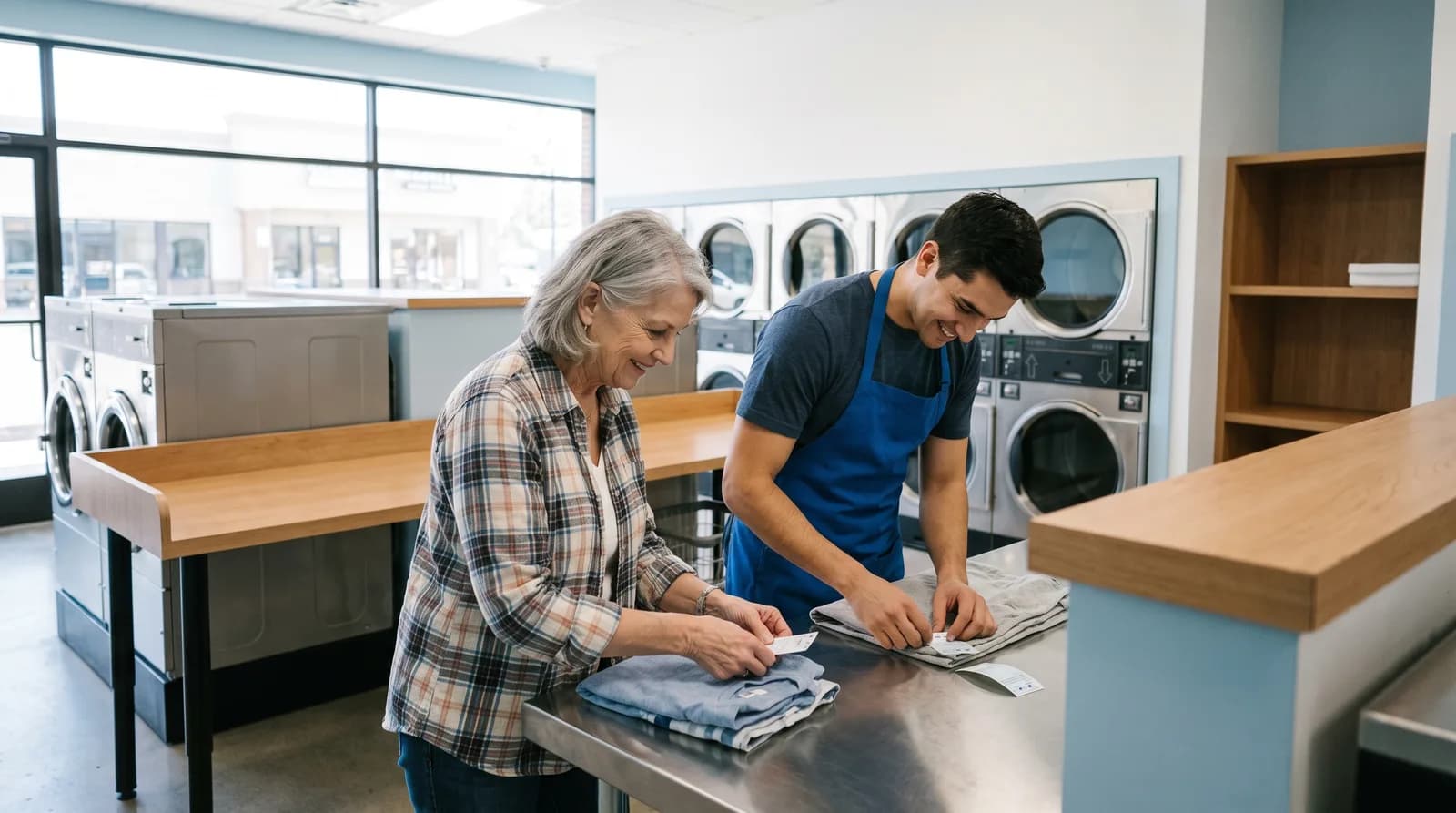
To hire and train a good laundromat attendant, source candidates locally, screen for reliability and honesty over laundry experience, pay a fair rate against your local minimum wage, and put every task on a written checklist so the store runs the same whether you are there or not. Attendants touch your cash, your machines, and your reputation, so the goal is a simple hiring process, a documented training routine, and a reason for the good ones to stay. This guide covers each step, from writing the job post to reducing turnover.
Key takeaways
- Screen attendants for reliability, honesty, and customer manner first, since laundry tasks are easy to teach but character is not.
- Write the job around real duties (wash-and-fold, cleaning, customer help, and cash handling) so candidates self-select.
- Train from a written checklist covering opening, closing, machine faults, cleaning, and cash so the store runs consistently.
- Pay at or modestly above your local market and minimum wage, and treat scheduling and respect as retention tools.
- Protect cash from day one with dual control, cameras, and reconciliation, because cash handling is the highest-risk task.
Contents
- What does a laundromat attendant actually do?
- Where do you find good attendants?
- What should the job post say?
- What interview questions actually predict a good hire?
- How should you screen for honesty and reliability?
- What should new-attendant training cover?
- How do you train wash-and-fold quality?
- How do you protect cash while training?
- What should you pay an attendant?
- How do you keep good attendants?
- What are the legal and payroll basics?

What does a laundromat attendant actually do?
An attendant keeps the store clean, helps customers, runs wash-and-fold, and protects your machines and cash during their shift. Defining the role precisely is the first step, because a vague job leads to a vague hire.
Core duties for most stores:
- Greet and help customers, especially new ones choosing machines.
- Process wash-and-fold orders to a consistent standard.
- Clean machines, folding tables, floors, and restrooms on a schedule.
- Report and sometimes clear minor machine faults.
- Handle change, refunds, and any cash carefully and by the rules.
Before you write the job, be clear on which of these you are delegating. If you are still deciding whether to staff at all, start with when to hire an attendant for your laundromat.
Where do you find good attendants?
The best attendants usually come from your own neighborhood and existing customer base, because they already know the store and live nearby. Local sourcing also tends to lower turnover and no-shows.
Productive channels include:
- A hiring sign in the window, since regulars already trust the store.
- Referrals from current customers and staff, often your best source.
- Community job boards, local social media groups, and neighborhood apps.
- General job sites for wider reach when local sourcing runs dry.
People who already do wash-and-fold at home, retirees wanting part-time work, and students needing flexible hours all tend to fit the role well. Prioritize candidates who can reliably cover your peak window rather than the most impressive resume.
What should the job post say?
A good post lists real duties, honest hours and pay range, and the traits that matter, so unqualified or mismatched candidates screen themselves out. Vague posts attract volume, not fit.
Include in the listing:
- Plain job title and one-line summary of the role.
- The actual shift pattern and weekly hours, including weekend needs.
- A pay range, stated honestly, near your local market.
- The must-haves: dependability, comfort with customers, ability to stand and lift laundry.
- A simple way to apply and a note that a short in-store trial is part of hiring.
Stating the pay range up front saves everyone time and signals that you run the store straight.
What interview questions actually predict a good hire?
The questions that predict success ask about past behavior, not hypotheticals, because how someone handled a real situation beats how they say they would. Keep the interview short and grounded.
Useful questions:
- Tell me about a time you had to be somewhere on time for weeks straight. How did you manage it?
- Describe a difficult customer you dealt with and what you did.
- What would you do if a machine stopped mid-cycle with a customer's clothes inside?
- If the coin count did not match at the end of a shift, what would you do?
- Which shifts can you commit to, and what would make you miss one?
Listen for concrete answers and honesty about limits. A candidate who admits they cannot do Sunday mornings is more useful than one who overpromises.

How should you screen for honesty and reliability?
Screen with a short paid trial shift and reference checks rather than relying on the interview alone, because cash and reliability problems show up in behavior, not conversation. A person who is warm in an interview can still be a poor fit on the floor.
Practical screening steps:
- Run a paid trial shift and watch punctuality, effort, and customer manner.
- Call at least one past employer or reference about dependability.
- Watch how they handle the register and change during the trial.
- Note whether they follow the checklist or freelance their own way.
Because attendants handle cash, reliability and honesty carry more weight than speed. You can teach folding; you cannot easily teach showing up.
What should new-attendant training cover?
Training should cover every routine task in writing so the store runs the same on any shift, not from memory. The backbone is a checklist the attendant can follow without you present. This is also where your standard operating procedures turn into daily habit.
A first-week training checklist:
- Opening: open up, lights on, machine and restroom check, floor walk.
- Customer help: machine selection, vend prices, refunds, lost-and-found.
- Machine faults: what to try, what to tag out of order, who to call.
- Cleaning: the daily and weekly cleaning routine, restrooms included.
- Cash: change handling, refund logging, and end-of-shift counts.
- Closing: final clean, machine sweep, cash secured, lock-up, alarm.
- Safety and emergencies: water shutoff, gas smell, injured customer, who to call.
Walk each item with the new hire, then have them do it while you watch, then let them run a shift with you reachable by phone.
How do you train wash-and-fold quality?
Train wash-and-fold to a single written standard so every order looks the same, because inconsistency is the fastest way to lose a paying wash-and-fold customer. This is the highest-margin service, so it deserves the most detailed instruction.
Set a standard for:
- Sorting rules, water temperature, and detergent amounts.
- Handling of delicates, stains, and customer instructions.
- Fold style and packaging so orders look uniform.
- Ticketing and weighing so pricing is consistent.
For pricing and workflow depth, pair training with the wash and fold business guide. A new attendant should shadow several orders before running one alone.
How do you protect cash while training?
Protect cash from the first shift with dual control, cameras over the collection point, and reconciliation against water usage, since a new attendant is exactly when loose habits form. Trust is earned over time, not granted on day one.
Basic controls:
- Keep coin and card collections under owner or dual control early on.
- Position a camera over the register and any collection area.
- Reconcile coin counts to water usage and turns to catch gaps.
- Log every refund so the register balances.
These controls protect the attendant too, since clean records mean an honest employee is never wrongly suspected. Build the reconciliation habit before you hand over more responsibility.
What should you pay an attendant?
Pay at or modestly above your local market and minimum wage, because underpaying drives the turnover that costs far more than a slightly higher rate. Exact pay depends on your region, hours, and whether the role includes wash-and-fold. For ranges and coverage models, see laundromat attendant pay and scheduling.
| Cost lever | Why it matters | Note |
|---|---|---|
| Base hourly rate | Sets your competitiveness and retention | Anchor to local minimum wage |
| Overtime | Adds up fast on long weeks | Follow federal and state rules |
| Payroll taxes | Raises true cost above the wage | Budget above the base rate |
| Workers' comp | Generally required with employees | Confirm coverage before hiring |
| Turnover cost | Re-hiring and re-training is expensive | Fair pay is cheaper than churn |
Confirm wage, overtime, and classification rules with the U.S. Department of Labor rather than assuming, since they vary by state and city.
How do you keep good attendants?
You keep good attendants with steady schedules, respect, and small raises tied to reliability, because the thing most part-time workers value after pay is a predictable shift. Turnover is expensive, so retention is an operating priority, not a nicety.
What tends to keep people:
- A consistent, published schedule they can plan life around.
- Fair pay reviewed at least once a year.
- Clear expectations so they are not guessing what good looks like.
- Being heard on problems with machines, supplies, or difficult customers.
- Modest bonuses tied to clean stores, good reviews, or wash-and-fold growth.
What are the legal and payroll basics?
Most attendants are employees, not contractors, which means payroll taxes, proper classification, and usually workers' compensation, though the specifics vary by state. Do not treat a regular scheduled attendant as a 1099 contractor just to save on taxes, since misclassification carries real risk.
General points to confirm with a professional:
- Worker classification and why scheduled attendants are typically W-2 employees.
- Minimum wage, overtime, and break rules for your state and city.
- Workers' compensation and unemployment insurance requirements.
- Recordkeeping for hours and pay.
Start with the U.S. Department of Labor and the IRS for authoritative guidance, and see laundromat payroll and attendant taxes for how this fits your books. Treat this as general information, not legal or tax advice, and verify with a qualified advisor before you hire.
Frequently asked questions
Do laundromat attendants need prior laundry experience?
No. Folding, sorting, and machine help are quick to teach, so most owners hire for reliability, honesty, and customer manner instead. A dependable person from your neighborhood with no laundry background usually outperforms an experienced hire who shows up late. Save the detailed training for wash-and-fold quality, where consistency actually matters.
How long does it take to train a new attendant?
Most attendants can run a basic self-service shift within a few days using a written checklist, then reach full speed on wash-and-fold over a couple of weeks. Shadowing real orders and having you reachable by phone shortens the curve. The written SOPs are what let a new hire perform consistently without you present.
Should I use a paid trial shift before hiring?
A short paid trial shift is one of the best screens available, because punctuality, effort, and cash handling show up in behavior rather than in an interview. Pay for the time worked and watch how the candidate follows the checklist. It protects both sides before either commits.
Are laundromat attendants W-2 employees or 1099 contractors?
A regularly scheduled attendant is almost always a W-2 employee, not a contractor, because you control their hours and how they work. Misclassifying them to avoid payroll taxes carries real legal and tax risk. Confirm classification with the IRS, the Department of Labor, and a qualified professional for your situation.
How do I reduce attendant turnover?
Give a steady, published schedule, pay fairly against your local market, set clear expectations, and review pay at least yearly. Predictable shifts and respect keep part-time workers more than small pay bumps alone. Since re-hiring and re-training is costly, retention is worth treating as an operating priority.
How many attendants does one laundromat need?
Many stores start with a single part-time attendant on the busiest window and add hours only as wash-and-fold and traffic grow. Larger or attended 24-hour stores may need several, plus a lead for scheduling. Let turns per day and service volume drive the count rather than staffing every open hour.