Cash Flow vs Revenue: Understanding Laundromat Financials
SudsList Editorial · Jun 26, 2026
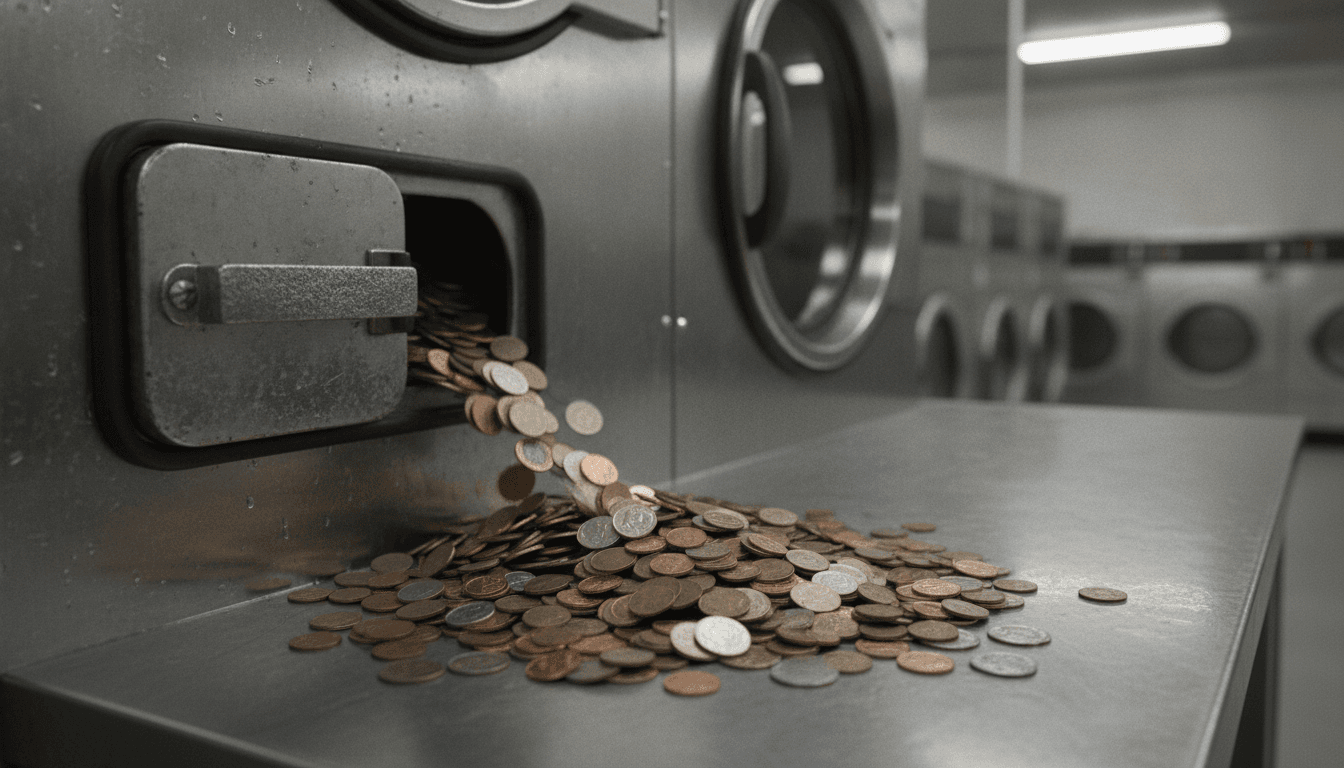
Laundromat cash flow is the money left after every operating expense is paid, and it, not revenue, is what you are actually buying. Revenue is the total of all quarters, card swipes, and wash-dry-fold tickets a store collects in a year. Cash flow, usually quoted as seller's discretionary earnings (SDE), is what remains after rent, utilities, insurance, and the rest are covered. A laundromat can post strong revenue and still leave the owner almost nothing, which is exactly why every offer should be built on cash flow rather than the headline number.
Key takeaways
- Revenue is total collections; cash flow (SDE) is what is left after operating expenses. You buy the cash flow, not the revenue.
- Laundromats are priced on a multiple of SDE, commonly 3x to 5x, so a revenue figure on its own tells you almost nothing about a fair price.
- Rent and utilities are the two costs that decide whether high revenue becomes real cash flow; together they often run 35% to 55% of revenue.
- Add-backs legitimately raise SDE, but inflated add-backs are the most common way a seller dresses up a weak store.
- Rebuild the cash flow yourself from utility bills, the lease, and tax returns. Never accept the seller's number on faith.

In this guide
- What is the difference between revenue and cash flow?
- What is the difference between SDE and EBITDA?
- Why do laundromats sell on cash flow, not revenue?
- What expenses turn revenue into cash flow?
- What does a normal expense breakdown look like?
- What are add-backs, and which ones are legitimate?
- A worked example: two stores, same revenue
- How does cash flow set the purchase price?
- How do you verify the cash flow number?
What is the difference between revenue and cash flow?
Revenue is every dollar that comes in; cash flow is every dollar that stays. For a laundromat, revenue is the gross collected from self-service machines, wash-dry-fold, vending, and any ATM or amusement income. Cash flow is that gross minus the cost of running the store.
The gap between the two is the whole point. A store can collect a healthy gross and still produce thin cash flow if its rent is high or its water and gas bills are heavy. Two stores with identical revenue can be worth very different amounts, because what a buyer pays for is the money that survives the expenses, not the money that passes through the registers.
What is the difference between SDE and EBITDA?
SDE includes the owner's pay; EBITDA assumes a hired manager and excludes it. Both are cash-flow measures, but they answer slightly different questions, and using the wrong one distorts a valuation.
SDE (seller's discretionary earnings) is the profit a single owner-operator actually takes home, including their own salary and any personal benefits run through the business, before loan interest, taxes, and depreciation. It is the right number for most single-store laundromat deals, where the buyer will run or closely oversee the store.
EBITDA (earnings before interest, taxes, depreciation, and amortization) excludes the owner's pay because it assumes a salaried manager runs the business. It is more common for larger or multi-store operations bought as hands-off investments. The practical rule: if you are buying a store you will operate or manage yourself, value it on SDE; if you are buying scale you will staff with a manager, EBITDA is the cleaner figure. Confusing the two is a frequent source of overpaying.
Why do laundromats sell on cash flow, not revenue?
Because the price is a multiple of cash flow, not revenue. Laundromats commonly trade at roughly 3x to 5x SDE, with newer equipment, a long lease, and verifiable books pushing toward the high end. Revenue never sets the price directly; it only matters insofar as it produces SDE.
This is why a seller who leads with "this store grosses six figures" is telling you almost nothing. The first question back is always: what is the cash flow, and how is it documented? If you want to see how the multiple translates into a number, our laundromat valuation guide and the cash flow multiple guide walk through it, and the calculators let you test a price against a given SDE.
What expenses turn revenue into cash flow?
The expenses that matter most are rent and utilities, because they are large, fixed, and unavoidable. Walk every line before you trust a profit figure.
- Rent (plus CAM and taxes). Often the single biggest cost. A healthy laundromat usually keeps occupancy cost in the range of 15% to 25% of revenue. Above that, cash flow gets squeezed fast, and the lease terms become the most important document in the deal.
- Utilities. Water, sewer, gas, and electric are the defining laundromat expense and frequently run 15% to 30% of revenue. Old, inefficient machines burn more of every dollar; the U.S. EPA's Energy Star program documents how much efficient commercial laundry equipment can cut water and energy use.
- Labor, if the store is attended or offers wash-dry-fold.
- Insurance, licenses, and waste removal.
- Repairs and maintenance, which rise sharply as equipment ages.
- Card or app processing fees on cashless systems.
What is usually *not* in operating expenses, and is added back to reach SDE, is the owner's own salary, loan interest, and depreciation. Keep those separate in your head, or the comparison breaks down.
What does a normal expense breakdown look like?
A useful sanity check is to convert each major cost into a percentage of revenue. The table below shows the ranges that are typical for a self-service-focused store; a store well outside these ranges deserves a closer look, not an automatic pass or fail.
| Expense line | Typical share of revenue | What to watch for |
|---|---|---|
| Rent + CAM + property taxes | 15%–25% | Above 25% squeezes cash flow; check escalations |
| Utilities (water, sewer, gas, electric) | 15%–30% | Older machines push to the high end |
| Labor | Near zero to moderate | Near zero for pure self-service; rises with wash-dry-fold |
| Insurance, licenses, waste removal | Low single digits | Should never be missing entirely |
| Repairs and maintenance | Rises with equipment age | A missing or tiny line often hides deferred upkeep |
| Card / app processing | Small % of cashless sales | Coin-only stores pay none |
Treat these as a frame, not a formula. The point is to spot the lines that are implausibly low, which is usually where a seller has trimmed costs to flatter the bottom line.
What are add-backs, and which ones are legitimate?
An add-back is an expense on the books that a new owner would not actually pay, added back to reported profit to show the store's true earning power. Legitimate add-backs are real and verifiable; inflated ones are how a weak store gets dressed up.
Reasonable add-backs include the owner's salary, one-time costs (a single equipment purchase, a one-off repair), personal expenses run through the business, and interest on the seller's loan. Add-backs to challenge include "owner doesn't take a paycheck" on a store that clearly needs an attendant, vague "miscellaneous" cash adjustments, and recurring maintenance reclassified as one-time. Every add-back should come with a document. If a seller cannot show the bill, drop it from your number. This is one of the most common red flags when buying a laundromat.
A worked example: two stores, same revenue
Consider two stores, each collecting $240,000 a year. On revenue alone they look identical.
Store A pays $36,000 in rent (15% of revenue) and has newer, water-efficient machines, so utilities run $48,000 (20%). With $20,000 in other costs, expenses total $104,000, leaving roughly $136,000 in SDE. At a 4x multiple, that supports a price near $544,000.
Store B pays $60,000 in rent (25%) and runs older equipment, so utilities hit $72,000 (30%). With the same $20,000 in other costs, expenses total $152,000, leaving about $88,000 in SDE. At the same 4x multiple, that is roughly $352,000.
Same revenue, but nearly $200,000 difference in fair value, driven entirely by rent and utility efficiency. This is why a buyer who anchors on the gross overpays, and why rebuilding cash flow is the core of due diligence.
How does cash flow set the purchase price?
Price is cash flow multiplied by a multiple, so every dollar of verified SDE is worth several dollars of price. At a 4x multiple, $10,000 of additional, provable annual cash flow adds roughly $40,000 to what the store is worth, and $10,000 of cash flow you cannot prove subtracts the same from what you should pay.
That leverage cuts both ways and is why the verification work pays for itself. It also explains why small, durable improvements, a modest price increase a card system makes easy, a trimmed utility bill from efficient machines, matter so much: they raise the multiple-able base. When you model a deal, separate the cash flow you can document today from the upside you hope to create, and only pay the seller for the former. The calculators let you turn an SDE figure into a price range at different multiples.
How do you verify the cash flow number?
You verify it by rebuilding it from primary documents, not from the seller's summary. The seller's spreadsheet is a claim; the bills are the evidence.
- Pull the last two to three years of federal tax returns and match them to the profit-and-loss statement.
- Get 12 months of actual water, sewer, gas, and electric bills, and check them against reported utilities.
- Read the full lease, including renewal options and any rent escalations, and confirm the rent used in the P&L.
- Independently estimate collections where you can, for example by reviewing the store's revenue records and card-system reports rather than trusting a stated figure.
- Strip out every add-back you cannot document, and rebuild SDE from what remains.
If the rebuilt number is close to what the seller claims, that is a good sign about both the store and the seller. If it comes in well below, you have either found your negotiating room or your reason to walk. When financing, lenders will run their own version of this exercise; the U.S. Small Business Administration's 7(a) loan program underwrites against documented cash flow, so unverifiable income cannot be borrowed against anyway. The Coin Laundry Association publishes industry benchmarks worth reviewing alongside any single store's books at coinlaundry.org. When you are ready to compare real stores on these terms, the listings are the place to start.
Frequently asked questions
Is SDE the same as profit on a laundromat?
SDE (seller's discretionary earnings) is a specific kind of profit: the total benefit a single owner-operator takes home, including their own salary and any personal expenses run through the business, before loan interest and depreciation. It is the standard cash flow figure laundromats are priced on. Plain accounting net profit is usually lower because it subtracts the owner's pay and financing costs.
What is a good cash flow margin for a laundromat?
There is no single number, but after rent and utilities a healthy self-service store often converts a meaningful share of revenue into SDE once the owner's labor is added back. Rent above 25% of revenue or utilities above 30% are the usual reasons margin is thin. Rebuild the expenses line by line rather than trusting a stated margin.
Why does revenue alone not tell me what a laundromat is worth?
Because price is a multiple of cash flow, not revenue. Two stores with identical revenue can have very different SDE depending on rent and utility efficiency, and therefore very different fair values. A revenue figure with no expense detail cannot be valued.
What are add-backs and should I trust them?
Add-backs are expenses on the books that a new owner would not pay, added back to reported profit to show true earning power, such as the owner's salary or a one-time repair. Trust the ones backed by a document and remove the ones that are vague or that you would actually have to pay, like an attendant's wages on a store that needs to be staffed.
How do I confirm a laundromat's real cash flow before buying?
Rebuild it from primary documents: two to three years of tax returns, 12 months of actual utility bills, the full lease, and the card or coin collection records. Strip out any add-back you cannot document and compare your rebuilt SDE to the seller's claim. A large gap is either negotiating room or a reason to walk.