Red Flags When Buying a Laundromat
SudsList Editorial · Jun 23, 2026

The clearest red flags when buying a laundromat are revenue you cannot verify, a short or punishing lease, equipment near the end of its life, a weak location, and a seller who avoids scrutiny. Any one of these can turn an attractive-looking store into a costly mistake. The good news is that every red flag below is detectable before you commit, if you insist on documents and take the time to check. This guide names the warning signs and tells you when each is a reason to negotiate hard or walk away.
Key takeaways
- Unverifiable revenue is the most dangerous red flag, because price is a multiple of cash flow you may be unable to confirm.
- A short, expiring, or escalating lease can make even a profitable store nearly worthless to a buyer.
- Equipment near the end of its 15-to-20-year life is a large future cost; a missing repair line often hides deferred maintenance.
- A weak or declining location caps revenue and cannot be fixed, no matter how good the price looks.
- An evasive seller who resists basic verification is itself a red flag; honest sellers expect and welcome due diligence.

In this guide
- What are the financial red flags?
- What are the lease red flags?
- What are the equipment red flags?
- What are the location red flags?
- What seller behavior is a red flag?
- Red flags at a glance
- When should you walk away?
What are the financial red flags?
The biggest financial red flag is revenue or cash flow that cannot be verified against independent records. A large share of laundromat income is cash, so a seller can overstate it, and you would pay a multiple of a number that is partly fiction.
Watch specifically for:
- No tax returns. A seller who will not provide two to three years of federal returns cannot prove the income.
- "Unreported cash." Income hidden from the IRS cannot be verified or financed and should not be valued.
- Utilities too low for the revenue. Real laundry uses real water and gas; a high top line with tiny utility bills suggests inflated or salted collections, a tactic covered in our guide to common laundromat scams.
- Oversized add-backs, which inflate the cash flow figure and the price.
The defense is to rebuild the numbers yourself, separating revenue from real cash flow and confirming income through the store''s actual records.
What are the lease red flags?
The major lease red flags are a short remaining term, no renewal options, and steep rent escalations. A laundromat is a long-term, equipment-heavy business, so the lease often matters more than the equipment, and a bad one can end the business.
A lease with two or three years left and no options puts your whole investment at the landlord''s mercy at renewal. Rent already above roughly 25% of revenue squeezes cash flow, and a modest current rent scheduled to jump can quietly destroy future profit. Read the full document, not the broker''s summary, as our guide to reviewing a laundromat lease details. A genuinely strong store on a weak lease is one of the most common traps for first-time buyers.
What are the equipment red flags?
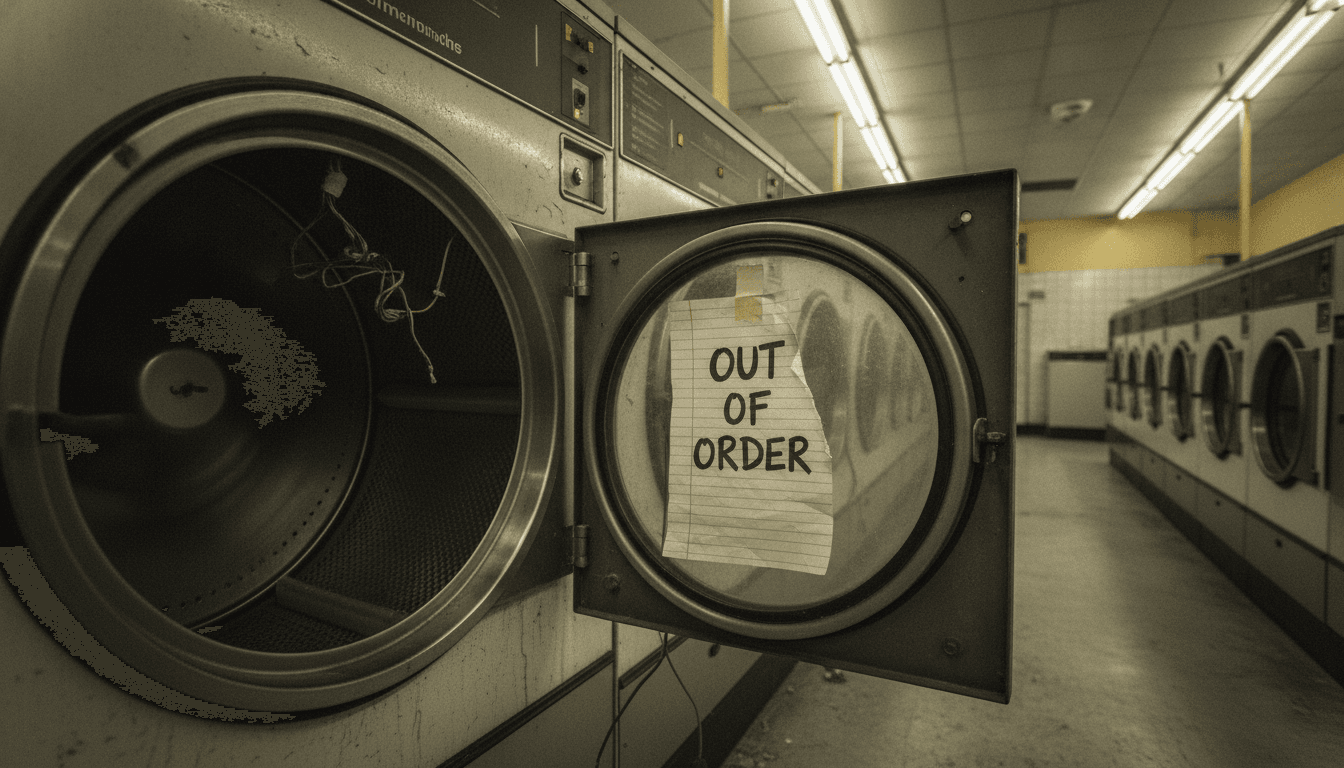
The equipment red flags are machines near the end of their life presented as healthy, and books that hide deferred maintenance. Commercial washers and dryers last 15 to 20 years, so a fleet near that age is a major capital cost coming your way.
Look for repainted or freshly cleaned machines that are actually old, a suspiciously low or missing repair line on the P&L, and building systems, water heaters, plumbing, and electrical, that the seller has stopped maintaining before exiting. Inefficient old equipment also drives up utilities, your biggest variable expense; the Energy Star program documents how much efficient machines save. Get the age, make, and model of every washer and dryer, and price replacement into your offer rather than discovering it after closing.
What are the location red flags?
The location red flags are a shrinking customer base, heavy competition, and poor access, none of which you can change. Because a laundromat draws from a small radius, a weak location sets a hard ceiling on revenue.
Be cautious when the surrounding area is losing population or households, when several modern competitors already serve the demand within a short drive, or when the store is hard to see, reach, or park at. A neighborhood shifting toward single-family homes with in-unit laundry is a quiet long-term threat. A low price often reflects exactly these problems, which is why a cheap store is not automatically a good one. Assess the site the way our guide to a great laundromat location describes before you weigh the price.
What seller behavior is a red flag?
Evasiveness and pressure are the behavioral red flags. A seller confident in their store provides documents and expects scrutiny; a seller hiding something resists it and tries to rush you.
Be wary of refusal to share tax returns or utility bills, pressure to skip due diligence or "decide today," bragging about cash that is off the books, and answers that change between conversations. Inconsistencies between what you are told and what the documents show are especially telling. None of this proves fraud, but it raises the burden of proof, and a seller unwilling to meet it is making your decision for you.
Red flags at a glance
The fastest way to triage a deal is to separate the flags you can fix from the ones you cannot. The table sorts the common red flags by what they signal and whether they are workable.
| Red flag | What it signals | Fixable? |
|---|---|---|
| Unverifiable revenue | You may be paying for fiction | No, walk away |
| Short or expiring lease | The business could simply end | Rarely |
| Steep rent escalation | Future cash flow quietly erodes | Negotiate or walk |
| End-of-life equipment | A large near-term capital cost | Yes, price it into the offer |
| Declining location | A hard ceiling on revenue | No, walk away |
| Evasive seller | Hidden problems and weak proof | Depends on what surfaces |
Notice that the unfixable flags cluster around the things you cannot change after closing: the location, the lease, and whether the income is real. The fixable ones tend to be operational or equipment issues with a known price. That split is the whole decision in miniature, pay to solve what is fixable, and walk from what is not, rather than hoping a structural problem improves on your watch.
When should you walk away?
Walk away when the fundamentals are broken or the numbers cannot be verified, and negotiate when the problems are fixable and priced in. The distinction is whether you can change the issue.
Things you can fix, like outdated marketing, a thin service mix, or even aging equipment with a known cost, are negotiating points. Things you cannot fix, like a declining location, a punishing lease with no options, or a seller who will not document income, are reasons to walk. Use the calculators and a check on whether the store is overpriced to put a number on the risk, and fold every flag into a full due diligence review. The best deals survive scrutiny; the worst ones are the reason you scrutinize. When you are ready to compare honestly presented stores, start with the listings.
Frequently asked questions
What is the biggest red flag when buying a laundromat?
Revenue that cannot be verified. Because much of a laundromat's income is cash, a seller can claim a higher figure than the store earns, and you would pay a multiple of a number that is not real. If the seller cannot back revenue with tax returns, utility bills, and collection records, treat the figure as unproven and do not value the store on it.
How short a lease is a red flag on a laundromat?
A lease with only a few years left and no renewal options is a serious red flag, because a laundromat is an equipment-heavy, long-term business that the landlord could effectively end at expiration. Look for ample remaining term plus options, and read the rent escalations. A great store on a short or expiring lease can be nearly worthless to a buyer.
Are old machines a reason not to buy a laundromat?
Not by themselves, but equipment near the end of its 15-to-20-year life is a major upcoming cost you must price in, not ignore. The red flag is a seller presenting worn machines as fine, or books with no repair line hiding deferred maintenance. Get the age of every machine and budget for replacement before you agree on a price.
What seller behavior should make me walk away?
Evasiveness and pressure. A seller who will not share tax returns, rushes you past due diligence, brags about unreported cash, or gives inconsistent answers is showing you the risk. Honest sellers expect scrutiny and provide documents. When the resistance is to basic verification, that resistance is your answer.
Can a cheap laundromat still be a bad deal?
Yes. A low price often reflects a weak location, a bad lease, or worn equipment, all things you cannot easily fix. Price is only attractive relative to verified cash flow and the cost to address what is wrong. A cheap store in a declining area with two years left on its lease can cost you far more than its asking price.