Laundromat Management Software
SudsList Editorial · Jul 26, 2026
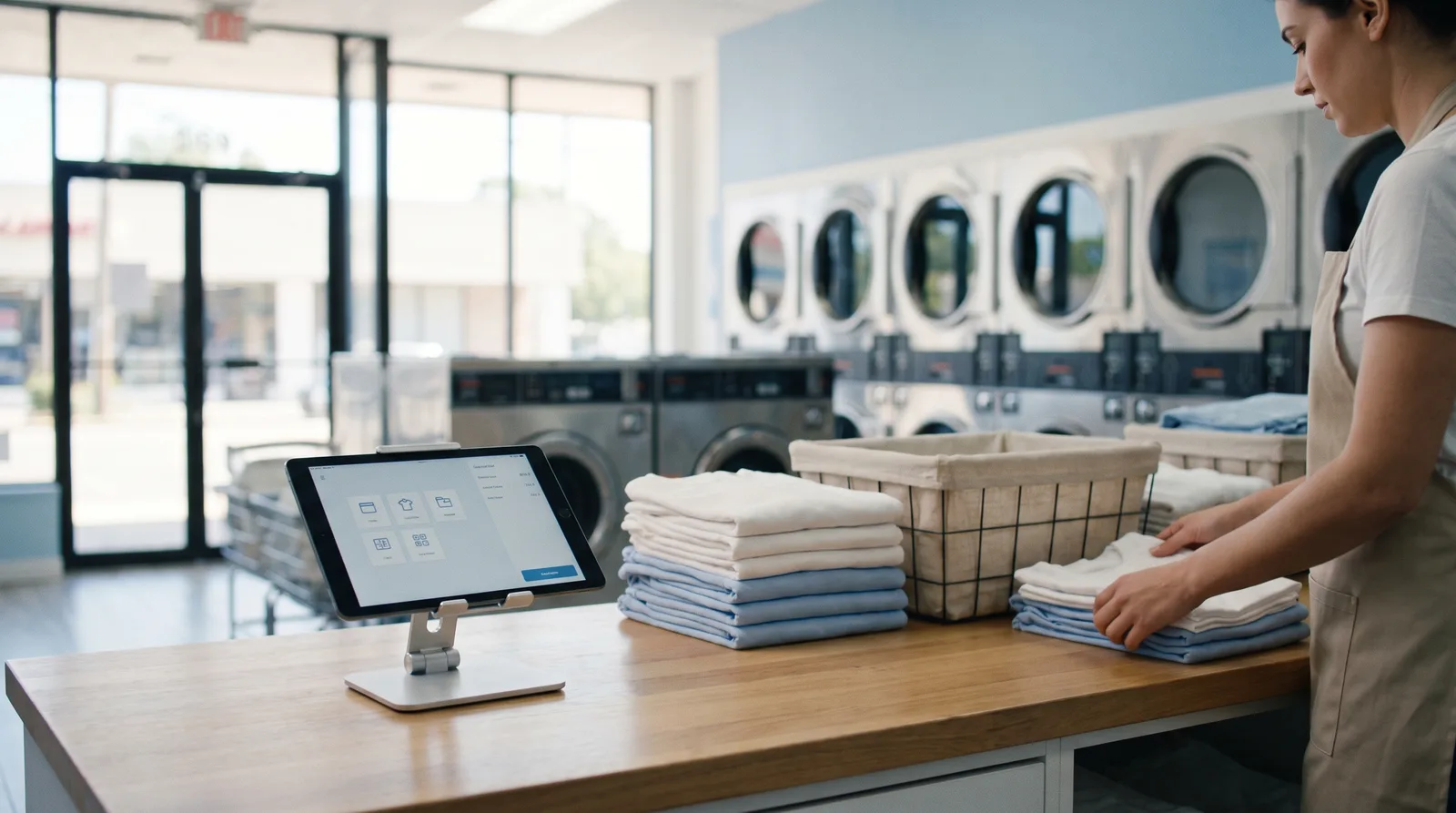
Laundromat management software is a point-of-sale and operations system that handles payments, wash-and-fold tickets, pickup and delivery orders, and revenue reporting from one place, so you can price, track, and run the store from a dashboard instead of a cash box and a notebook. At its core it replaces manual, paper-based work with a connected record of every transaction, which is what makes accurate reporting, remote pricing, and a real wash-and-fold workflow possible. Not every store needs it: a small, self-service-only coin store may run fine without one, while any store doing meaningful wash-and-fold, delivery, or card payment quickly outgrows manual tracking. The trick is matching the software to what your store actually does and avoiding a system that locks you into one vendor's hardware and fees. This guide covers what these systems do and how to evaluate one.
Key takeaways
- Laundromat management software ties payments, wash-and-fold tickets, delivery orders, and reporting into one system instead of separate manual processes.
- The clearest need is a wash-and-fold, delivery, or card-payment operation, where paper tickets and a cash box no longer keep up.
- Reporting is often the biggest quiet benefit, since accurate revenue data supports pricing, staffing, and a cleaner sale later.
- Watch for vendor lock-in: some systems tie you to proprietary payment hardware and per-transaction fees.
- Match the software to what your store does now and plausibly will; paying for delivery routing you will never use is wasted money.
Contents
- What does laundromat management software do?
- Does your laundromat actually need it?
- How does it help with wash-and-fold and delivery?
- What reporting should it provide?
- How is it priced?
- How do you evaluate a system without getting locked in?
- What are the common mistakes?

What does laundromat management software do?
Laundromat management software centralizes the store's transactions and operations, typically covering payments, wash-and-fold order tickets, pickup and delivery scheduling, pricing, and reporting. Instead of a coin box, a paper ticket book, and a spreadsheet, you get one connected record that updates as the store runs.
Core functions usually include:
- Point-of-sale for wash-and-fold, self-service top-ups, and add-on sales.
- Payment acceptance across card, app, and often a store value card.
- Wash-and-fold ticketing that tracks an order from intake to pickup.
- Pickup and delivery scheduling and, in fuller systems, routing.
- Reporting on revenue, machine performance, and labor.
The more of these your store does, the more a single system beats stitching together separate tools. Industry groups such as the Coin Laundry Association offer vendor-neutral operating resources worth reading before you shortlist systems. If you are also weighing a payment retrofit, read this alongside coin-to-card conversion for laundromats, since payment and management software often come bundled.
Does your laundromat actually need it?
Whether you need management software depends on what your store does: a self-service-only coin store may not, while any store with meaningful wash-and-fold, delivery, or card payment usually does. The honest test is whether manual tracking is starting to fail you.
Signs you have outgrown paper and a cash box:
- Wash-and-fold volume where handwritten tickets get lost or mispriced.
- Delivery or business accounts that need scheduling and recurring billing.
- Card or app payment that already generates transaction data worth using.
- A revenue picture too fuzzy to make pricing or staffing decisions.
If none of those apply and you run a small coin store you collect yourself, software may be a cost without a return. Be honest about your operation rather than buying features. For where the self-service side stands on payment types, see coin vs card vs app payment systems.
How does it help with wash-and-fold and delivery?
For wash-and-fold and delivery, the software replaces paper tickets with tracked digital orders, which reduces lost items, pricing errors, and turnaround misses that damage those higher-margin services. Because wash-and-fold sells convenience and reliability, the order accuracy a system provides directly protects the revenue.
On the wash-and-fold side it typically:
- Creates an order at intake with weight, price, and pickup time recorded.
- Tracks each order through washing, folding, and ready-for-pickup.
- Sends customer notifications and stores payment on file.
For delivery it adds scheduling windows, recurring orders, and sometimes route building. If you are growing these services, pair the software decision with how to add wash-and-fold to your laundromat and how to start a laundry pickup and delivery business. A store still doing a handful of wash-and-fold orders a week can manage on paper, but the errors and effort climb fast with volume.

What reporting should it provide?
Good reporting is often the biggest quiet benefit, because accurate revenue and usage data supports pricing, staffing, cash reconciliation, and a cleaner sale later. Coin stores run partly blind; a system that logs every transaction turns guesswork into numbers.
Useful reporting includes:
- Revenue by day, service, and machine, so you see what actually earns.
- Turns and peak-hour patterns, which inform hours and staffing.
- Wash-and-fold and delivery order volume and margins.
- Reconciliation data that ties collections to usage and flags shrink.
Clean, exportable records also matter at tax time and when selling, since a buyer will scrutinize how revenue is documented. Keep them in a form your bookkeeper and the IRS would accept, and see how to verify a laundromat's revenue for why documented numbers raise a store's value.
How is it priced?
Management software is usually priced as a monthly subscription, sometimes bundled with payment hardware and per-transaction card fees, so the sticker price is rarely the full cost. Understanding the total load matters more than the headline monthly number.
| Cost element | What it is | Notes |
|---|---|---|
| Monthly subscription | Access to the platform and support | Often tiered by features or store size |
| Payment hardware | Readers, kiosks, terminals | May be bundled or sold separately |
| Per-transaction fees | Card and app processing | Scales with sales volume |
| Setup and onboarding | Install, configuration, training | Sometimes one-time, sometimes waived |
| Add-on modules | Delivery routing, extra reporting | Priced separately in some systems |
Because payment processing is often tied to the software, compare total cost at your real transaction volume, not just the subscription. If the system is bought as part of an equipment upgrade, financing options are covered in equipment financing for laundromats, and you can model the spend in the laundromat cash flow calculator.
How do you evaluate a system without getting locked in?
Evaluate a system by matching it to what your store does, checking whether it forces proprietary payment hardware, and confirming you can export your own data. Lock-in is the main risk, because a system tied to one vendor's hardware and processing rates is hard and costly to leave.
Before committing, ask:
- Does it fit my actual operation, self-service, wash-and-fold, delivery, or all three?
- Am I required to use the vendor's payment processing, and at what fee?
- Can I export my transaction and customer data if I switch?
- How does it behave during an internet or power outage?
- What are the contract length and cancellation terms?
Run a trial or a limited rollout before converting the whole store, and talk to other operators using the system. A tool that fits and lets you keep your data is worth more than a feature-rich one that traps you. Buy for the store you run, not the one a demo imagines.
What are the common mistakes?
The common mistakes are overbuying features, ignoring total cost, accepting vendor lock-in, and choosing a system that fails when the internet does. Each turns a helpful tool into a recurring cost or a liability.
Avoid these:
- Paying for delivery routing and B2B modules a self-service store will never use.
- Judging on the monthly price while ignoring per-transaction fees at real volume.
- Signing into proprietary hardware and processing without an exit path for your data.
- Overlooking offline behavior, so a network outage stops the store from taking payment.
Management software is a means to run the store better, not a goal in itself. Match it to your operation, understand the full cost, protect your data and your ability to switch, and it earns its place; skip those checks and it becomes another bill.
Frequently asked questions
What does laundromat management software actually do?
It centralizes payments, wash-and-fold order tickets, pickup and delivery scheduling, pricing, and reporting into one system instead of a cash box, a paper ticket book, and a spreadsheet. That connected record is what makes accurate reporting, remote pricing, and a real wash-and-fold workflow possible. The more services your store runs, the more a single system helps.
Does a small coin laundromat need management software?
Often not. A self-service-only coin store you collect yourself may run fine without one, and the subscription would be a cost without a clear return. The clearest need shows up once you have meaningful wash-and-fold, delivery, or card payment, where paper tickets and manual tracking start to fail.
How is laundromat management software priced?
Usually a monthly subscription, often bundled with payment hardware and per-transaction card fees, so the headline price is rarely the full cost. Because processing is frequently tied to the software, compare total cost at your real transaction volume. Watch for setup fees and separately priced add-on modules like delivery routing.
What is the biggest benefit of these systems?
Reporting is often the biggest quiet benefit, because accurate revenue and usage data supports pricing, staffing, cash reconciliation, and a cleaner sale later. Coin stores run partly blind, and a system that logs every transaction turns guesswork into numbers. Documented revenue also raises a store's value when you sell.
How do I avoid getting locked into one vendor?
Check whether the system forces you onto proprietary payment hardware and processing rates, confirm you can export your own transaction and customer data, and read the contract length and cancellation terms. Run a trial or limited rollout before converting the whole store. A tool that fits and lets you keep your data beats a feature-rich one that traps you.