Laundromat Bookkeeping Basics
SudsList Editorial · Aug 28, 2026
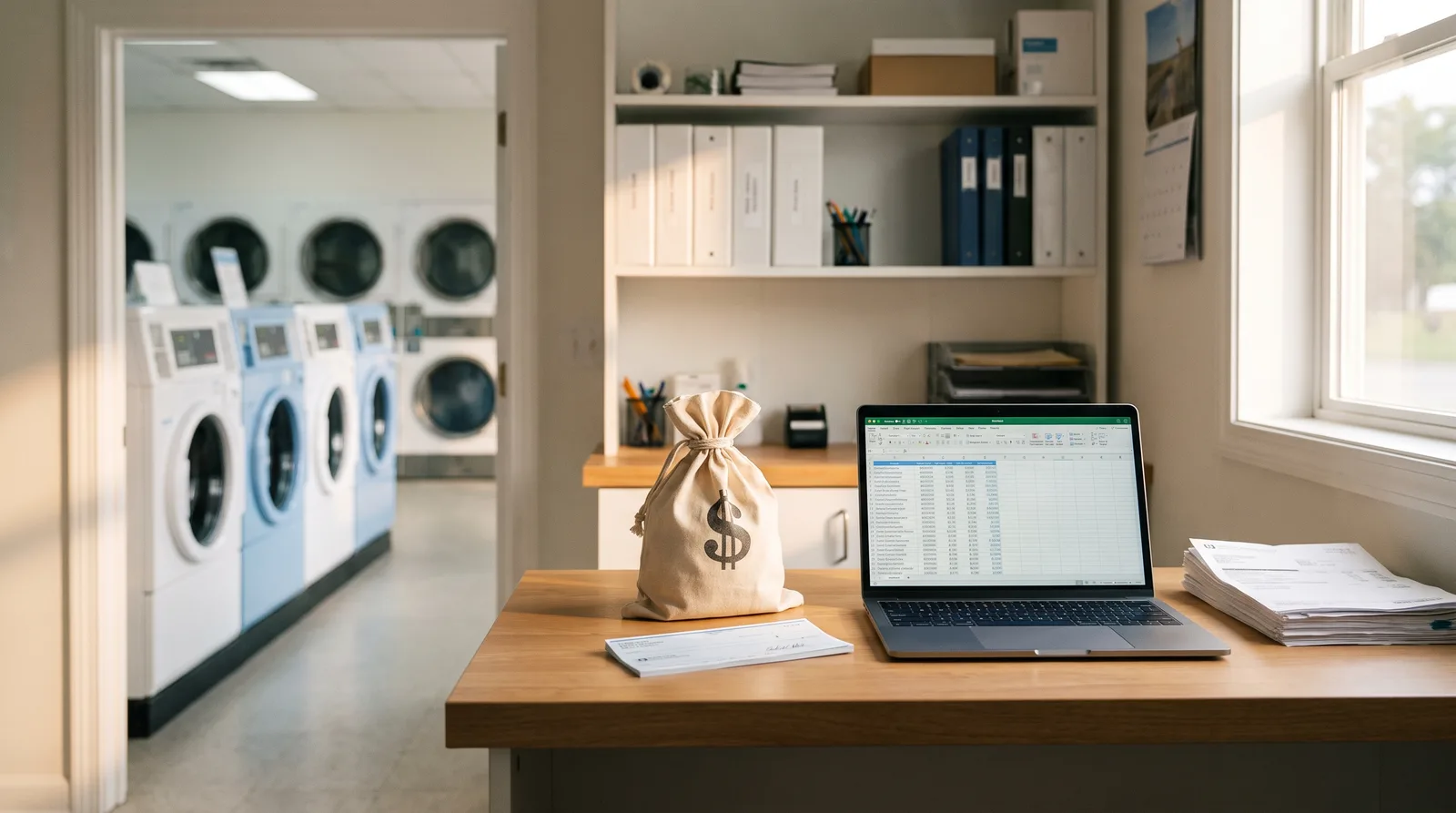
Good laundromat bookkeeping means recording every coin and card collection, every expense, and every cash movement in one consistent system, so your taxable income is accurate and the store is provable to a buyer or lender later. A laundromat is a cash-heavy, low-transaction business with no register tape, which makes clean books harder and more important than in most retail. The core habit is simple: reconcile what the machines collected against water usage and deposits, categorize expenses the same way every month, and keep the records a bookkeeper, the IRS, or a buyer could follow without you in the room.
Key takeaways
- Laundromat books stand or fall on the revenue side, because coin income has no automatic paper trail and must be reconciled by hand.
- Record collections, deposits, and expenses in one consistent system every week, not in a shoebox you sort at tax time.
- Reconcile coin counts to water usage and bank deposits, since that link is what proves your revenue is real.
- Categorize expenses the same way each month so utilities, rent, repairs, and labor stay comparable over time.
- Clean, reconciled books are what let you file accurate taxes and what a buyer or lender will demand before they pay.
Contents
- What does laundromat bookkeeping actually track?
- How do you record coin and card revenue?
- What expense categories should a laundromat use?
- Cash vs accrual: which does a laundromat use?
- How do you reconcile coin to water and deposits?
- Do you need software or an accountant?
- How do clean books help you sell the store?

What does laundromat bookkeeping actually track?
Laundromat bookkeeping tracks three things: money in (vend revenue and any wash-and-fold or vending income), money out (rent, utilities, labor, repairs, supplies), and cash movement between the machines, the count, and the bank. The goal is a monthly picture of what the store earned and spent that ties back to your bank statement.
What makes a laundromat different is the absence of a point-of-sale record on the coin side. A coffee shop rings every sale; a coin store just accumulates quarters. So the bookkeeping job is partly to manufacture the paper trail that other businesses get for free, by logging each collection and tying it to a deposit.
That single discipline supports everything downstream: accurate profit margins, a defensible tax return, and a story a buyer can verify. For how those numbers translate into profit, see laundromat profit margins explained.
How do you record coin and card revenue?
Record revenue at the point of collection: log the date, the machine bank or store total, and the counted amount, then match that amount to the bank deposit. For card and app payments, pull the processor report for the same period so both revenue streams land in your books.
A workable weekly routine looks like this:
- Collect on a fixed schedule and count under dual control.
- Write the counted coin total into a collection log with the date.
- Deposit the full amount and staple the deposit slip to that log entry.
- Download the card and app processor statement and record its total.
- Add any vending, wash-and-fold, or delivery income from its own record.
The rule that keeps you honest is depositing the full count intact, not spending cash out of the coin before it hits the bank. Paying an attendant or a repair from the collection bag breaks the trail and understates both revenue and expense. Card and app systems make this easier because they create their own report; compare the options in coin vs card vs app payment systems.
What expense categories should a laundromat use?
Use a small, consistent set of categories that match how a laundromat actually spends: rent, utilities (split into water and sewer, gas, and electric), labor, repairs and maintenance, supplies, insurance, and loan interest. Consistency month to month matters more than the exact list, because it lets you spot trends and compare periods.
| Category | What it captures | Why track it separately |
|---|---|---|
| Water and sewer | Metered water and sewer charges | Usually the largest variable cost and the key reconciliation check |
| Gas | Dryer and water-heater fuel | Second big utility, moves with turns |
| Electric | Lighting, machines, HVAC | Steadier, flags equipment or rate issues |
| Rent | Base rent, CAM, property tax pass-through | Largest fixed cost, drives rent-to-revenue |
| Labor | Attendant wages and payroll taxes | The line most stores can flex |
| Repairs and maintenance | Parts, service calls, PM | Rising trend signals aging equipment |
Keeping utilities split out is worth the small extra effort, because water and sewer usually dominate and are the number you reconcile revenue against. For the detail on that line, see laundromat water and sewer costs. Payroll taxes belong under labor and are their own subject; see laundromat payroll and attendant taxes.

Cash vs accrual: which does a laundromat use?
Many small laundromats use cash-basis accounting, meaning income and expenses are recorded when money actually moves, which fits a store that collects cash and pays bills as they come. Accrual accounting records income when earned and expenses when incurred, and larger operations or those with significant receivables may use it. Which method you may use and must use depends on your structure and revenue, and that is a question for a tax professional and the IRS, not a rule to assume.
Whatever method you choose, apply it consistently, because switching methods has tax consequences and confuses year-over-year comparisons. The practical point for most owner-operators is to pick a method with your accountant and then keep every entry on that basis.
This choice also shapes how cash flow reads versus reported profit. The two are not the same, and understanding the gap protects you from spending money the books say you have; see laundromat cash flow vs revenue.
How do you reconcile coin to water and deposits?
Reconciliation is the check that proves your coin revenue is real: you compare the counted collection against water usage for the same period and against the bank deposit, and investigate any gap. Water consumed roughly tracks wash cycles run, so a sudden drop in collections without a matching drop in water is a red flag for shrink.
A basic reconciliation each period is:
- Take the counted coin total for the collection period.
- Confirm it matches the deposit that hit the bank.
- Compare it against water usage or turn counts for the same window.
- Flag and investigate any collection that falls out of the expected range.
This is the single most important control in a cash business, and it is also your defense if revenue is ever questioned. For the full anti-shrink playbook, see how to track laundromat cash and prevent skimming, and use the laundromat cash flow calculator to model the store's monthly picture.
Do you need software or an accountant?
Most laundromats do better with simple accounting software plus a bookkeeper or accountant than with spreadsheets alone, because software enforces categories and an accountant handles the tax method and filings. A small store can start in a spreadsheet, but the collection log, deposit matching, and monthly categorization are what actually matter, not the tool.
A reasonable division of labor is:
- You or an attendant log collections and deposits weekly.
- Software or a bookkeeper categorizes expenses monthly.
- An accountant sets the method, files taxes, and advises on deductions.
The Coin Laundry Association offers operator resources that can help you set up a sensible chart of accounts for a store. Spend on the accountant before the fancy software; the judgment is worth more than the tool. Deductions and depreciation are their own area covered in laundromat tax deductions for owners.
How do clean books help you sell the store?
Clean, reconciled books are what let a buyer trust your revenue, and untrustworthy books cost you at sale more than any other single factor. A laundromat is valued largely on provable earnings, so if your coin income cannot be tied to deposits and water usage, a serious buyer discounts it or walks.
When you eventually sell, expect a buyer to compare your reported revenue against water bills, deposits, and tax returns. If those three tell the same story, the sale is smooth; if they conflict, every number is questioned. That is why the habits above pay off twice, once at tax time and again at exit.
Buyers verify exactly this during due diligence, so keeping the trail intact today prepares your future sale. See how the other side works in how to verify a laundromat's revenue, and when you are ready, list where operators look at laundromats for sale.
Frequently asked questions
How do I keep books for a coin laundromat with no register?
Create the paper trail by hand: log every collection with the date and counted total, deposit the full amount intact, and staple the deposit slip to the log entry. Then reconcile that total against water usage for the same period. The counted-to-deposited-to-water chain is what stands in for a register tape.
Should laundromat coin revenue be deposited before paying expenses?
Yes. Deposit the full counted collection into the bank, then pay attendants, repairs, and supplies from the account, not out of the coin bag. Spending cash before it is deposited breaks the revenue trail, understates both income and expense, and makes the books impossible to reconcile or defend.
Do laundromats use cash or accrual accounting?
Many small laundromats use cash-basis accounting because they collect and pay as money moves, but the method you may use depends on your structure and revenue. That is a question for a tax professional and the IRS, not a rule to assume. Whatever you choose, apply it consistently year to year.
How often should I do laundromat bookkeeping?
Log collections and deposits weekly while the details are fresh, and categorize expenses monthly so you have a clean picture each month. Waiting until tax time forces you to reconstruct a cash trail that no longer exists. A weekly and monthly rhythm keeps the books accurate and low-stress.
Why do clean books matter when selling a laundromat?
Laundromats are valued mostly on provable earnings, and a buyer will compare your reported revenue against water bills, bank deposits, and tax returns. If those agree, the sale goes smoothly; if they conflict, the buyer discounts your revenue or walks. Reconciled books protect your sale price.